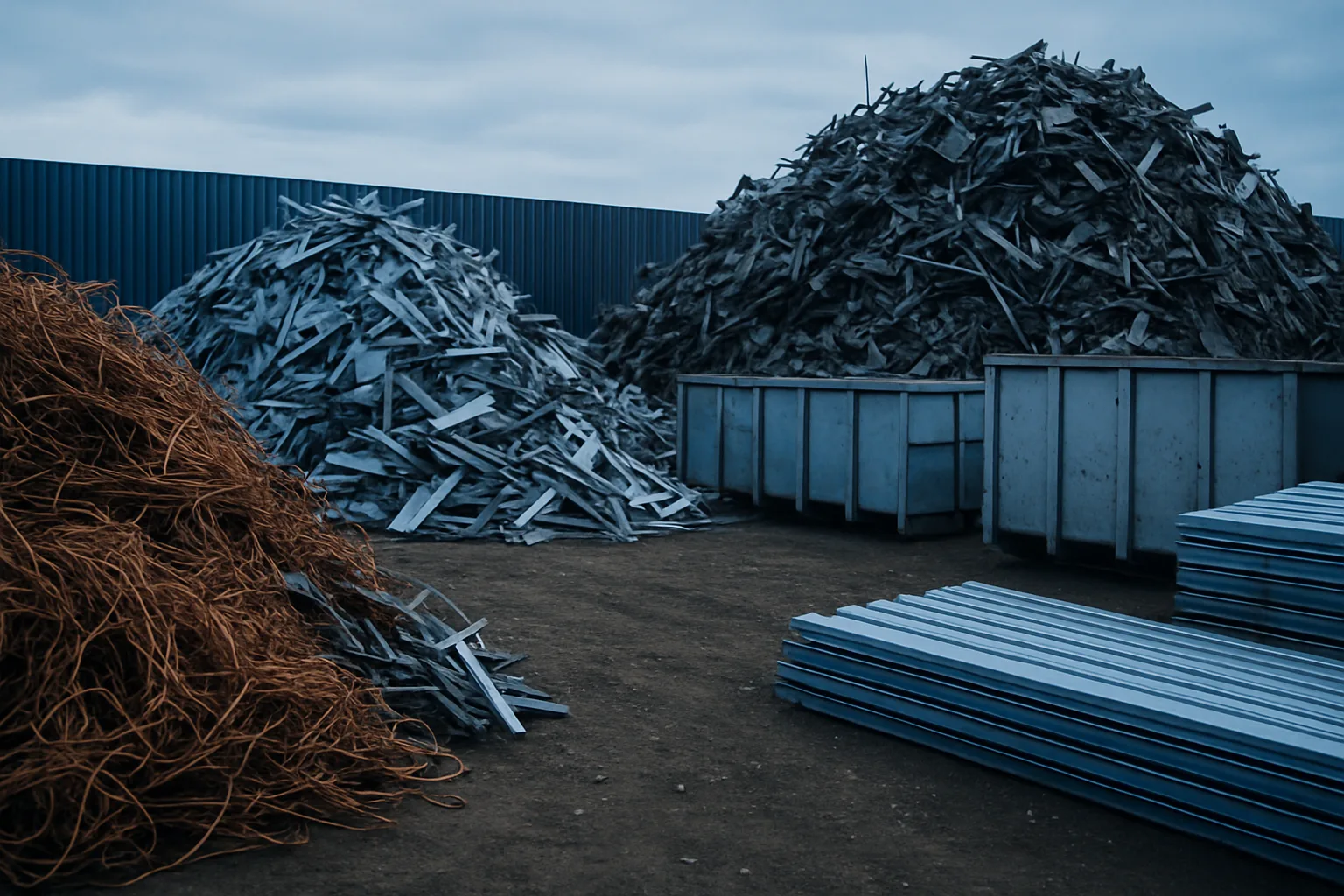
Steel Scrap Price Today: What Canadian Yards and Sellers Need to Watch Right Now
The scrap metal market in August 2026 is not sitting still. Steel prices are reacting to shifting global demand, copper is catching attention from energy sector buyers, and aluminum supply chains are still adjusting after years of disruption. If you're selling scrap — whether you're a yard operator in Lethbridge, a commercial fleet manager in Ontario, or a demolition contractor anywhere in Alberta — understanding what's moving the market right now could mean the difference between a fair deal and leaving money on the table.
This is what you need to know about the steel scrap price today, where other metals are heading, and how smart sellers are using better tools to capture more of what the market is actually willing to pay.
Disclaimer: Scrap metal prices fluctuate daily based on global commodity markets, regional supply and demand, and buyer competition. Always check current Canadian scrap metal prices before making selling decisions.
What's Driving the Steel Scrap Price Today in Canada
Steel scrap pricing in mid-2026 is being shaped by a few converging pressures. North American electric arc furnace (EAF) mills — the primary buyers of ferrous scrap — have been running at elevated capacity to meet infrastructure and manufacturing demand. That demand for scrap feed stock has kept prices from dropping off the floor, even as global steel oversupply from offshore producers continues to create headwinds.
On the export side, the situation is complicated. U.S. and Canadian yards that historically shipped containerized scrap to overseas mills are seeing tighter margins on exports due to freight cost volatility and buyer competition from domestic mills. For Canadian sellers, this creates an interesting dynamic: domestic mills are actively competing for quality ferrous loads, which should improve price discovery — if sellers are putting their loads in front of more than one buyer.
- Shredded steel: Demand from EAF mills remains the primary price driver
- HMS (Heavy Melting Steel) 1&2: Spread between grades has widened — know what you're grading before you sell
- Busheling and punching: Industrial and manufacturing generators in Alberta and Ontario are seeing solid demand from regional buyers
- Cast iron: Pricing has been relatively stable but remains sensitive to foundry capacity utilization
The takeaway for sellers: grading matters more than ever. Loads that are well-documented and properly categorized attract more confident bids. If your inventory is a guessing game for buyers, you'll pay for that uncertainty in lower offers.
Copper, Aluminum, and Non-Ferrous: The Numbers That Matter This Month
Non-ferrous metals continue to command premium attention, particularly copper. Energy transition infrastructure — EV charging networks, grid upgrades, and industrial electrification — is sustaining copper demand at levels that are keeping scrap copper prices well above historical averages. For yards and sellers with access to clean copper wire, bare bright, or #1 and #2 copper, now is not the time to sit on inventory without at least knowing what competitive buyers are willing to pay.
Aluminum is a different story. Automotive-grade aluminum demand has stayed strong, but pricing on lower-grade cast and mixed aluminum has been more volatile. Sellers in Lethbridge scrap metal services and across Alberta who are moving agricultural or industrial aluminum scrap should pay close attention to regional buyer appetite — it varies significantly from month to month and from buyer to buyer.
- Bare bright copper: Highest-value copper grade — proper stripping and sorting pays off
- #1 copper: Solid demand from wire and rod mills
- Aluminum extrusion (6063): One of the more stable non-ferrous grades right now
- Stainless steel (304/316): Nickel pricing directly impacts this — watch LME nickel movements
- Catalytic converters (cats): PGM markets remain active; serial tracking and photo documentation are non-negotiable for legitimate sales
For any seller dealing in non-ferrous, the margin between a mediocre offer and a competitive one can be significant. That gap is exactly where better price discovery tools — like a properly structured auction — make a real difference. Platforms like smashrecycling.ca are built specifically to put your loads in front of vetted buyers who are actively competing, not just waiting for you to accept whatever they quote.
Scrap Metal Inventory Management: Why Documentation Is Now a Competitive Advantage
One of the quieter shifts in the Canadian scrap market over the past few years has been the increasing importance of documentation. It's no longer just about having a load — it's about proving what's in it. Buyers are more selective. Mills want assurances on quality and composition. And regulatory compliance around high-value materials like cats and copper wire has made proper tracking a baseline requirement, not an extra step.
Strong scrap metal inventory management practice means more than keeping a spreadsheet. It means photo documentation of loads before they move, serial tracking on cores and catalytic converters, accurate grading by material type, and organized BOLs and packing lists that give buyers real information to bid on. When buyers can trust what they're bidding on, they bid higher. That's not a marketing claim — it's basic risk pricing.
For yards in Lethbridge and across Alberta managing regular volumes of industrial or demolition scrap, investing in inventory systems pays back every time a well-documented load attracts a stronger offer than a mystery load would. The SMASH platform includes inventory tools with VIN lookup, serial tracking, and photo documentation built in — because the data that supports your load is part of the value of your load.
Scrap Metal Prices Ontario and Beyond: How Regional Markets Differ
Canada is not one scrap market — it's several regional markets operating under different buyer pools, transport economics, and mill proximity. Understanding where scrap metal prices in Ontario sit versus pricing in Alberta or the prairies matters if you're comparing rates or sourcing buyers across regions.
Ontario benefits from dense mill and buyer concentration — Hamilton, the GTA, and southwestern Ontario have significant ferrous and non-ferrous buyer infrastructure. That competition tends to produce sharper pricing on bulk ferrous loads. In contrast, sellers in Alberta and on the prairies — including Lethbridge and communities across the province — sometimes deal with thinner local buyer markets, which makes access to a broader, national buyer pool even more valuable.
The same logic applies to best scrap metal prices in Winnipeg and other prairie-region markets. Regional buyers set prices partly based on what local competition allows. If you're only selling to the one or two buyers who drive your way, you're probably not seeing the full market. That's not their fault — it's a structure problem, and it's fixable.
- Ontario: Dense buyer network, strong ferrous pricing near mill clusters
- Alberta: Active industrial scrap generation; oil and gas sector feeds significant ferrous and specialty metal volume
- Manitoba/Prairies: Competitive but thinner buyer market; access to national buyers adds real value
- B.C.: Port access influences export-oriented scrap pricing; non-ferrous is particularly active
How the SMASH Scrap Metal Auction Model Changes Your Selling Strategy
The traditional scrap selling process — one call, one quote, accept or walk — isn't broken because sellers are naive. It's broken because it was never designed to surface real market value. When one buyer sets the price, you get that buyer's margin built in. That's just how it works.
The SMASH scrap metal auction model flips that. You list your load with documentation. Vetted buyers see it and compete. You see what the market actually thinks your load is worth. No subscription fees. No lock-in. SMASH earns when the transaction closes — which means the incentive is aligned with getting you a result, not just getting you to sign up.
For a yard operator in Lethbridge moving regular loads of ferrous, non-ferrous, or specialty metals, that competitive structure can reveal pricing you wouldn't have found through a single-buyer relationship. More buyers means better price discovery. That's not a pitch — it's math.
The platform also handles auto-invoicing, GST/HST documentation, and the administrative side that slows down manual transactions. Less friction means faster closes and cleaner records. If you're ready to find the best Canadian scrap metal prices today, the structure you sell through matters as much as the market you sell into.
What to Watch for the Rest of 2026
The second half of 2026 brings a few factors that Canadian scrap sellers should keep on their radar:
- Infrastructure spending timelines: Federal and provincial infrastructure commitments — including Alberta-specific projects — are feeding industrial scrap generation and maintaining steel demand from construction-adjacent buyers.
- LME metal price movements: Copper and nickel are the most relevant for non-ferrous sellers. Watch London Metal Exchange benchmarks as a directional indicator, not a quote.
- Freight and transport costs: Rail and trucking economics affect how far buyers can economically reach for loads. Sellers in mid-size markets like Lethbridge should track whether regional transport costs are shifting buyer behaviour.
- Regulatory tightening on high-value materials: Catalytic converter documentation requirements continue to evolve at the provincial level. Proper serial tracking and photo documentation are baseline compliance, not optional.
- Currency effects on export pricing: The CAD/USD spread directly affects what Canadian yards net on export-priced loads. Watch the exchange rate alongside metal prices.
Staying current on these factors is part of being a competitive seller. The Canadian scrap metal pricing guides at best-scrap-metal-prices.ca are updated regularly to help you track what's changing before it hits your next transaction.
The market is moving. The sellers who pay attention — and who put their loads in front of real competition — are the ones capturing the most of it. If you want to know where rates stand right now, get the best Canadian scrap metal prices — check rates at best-scrap-metal-prices.ca and stop guessing what your load is worth.
Frequently Asked Questions
Q: What is the steel scrap price today in Canada?
Steel scrap prices in Canada fluctuate daily based on mill demand, export conditions, and regional buyer competition. There is no single national price — rates vary by grade (HMS, shredded, busheling), region, and buyer. Always check current market rates before selling and get quotes from more than one buyer to understand what your load is actually worth.
Q: How do scrap metal prices in Lethbridge compare to other Alberta cities?
Lethbridge scrap prices generally track Alberta regional pricing, though local buyer competition and transport economics can create differences versus Calgary or Edmonton. Sellers in Lethbridge benefit from accessing a broader buyer pool — including buyers outside the immediate region — to ensure they're seeing competitive offers rather than just what local buyers choose to quote.
Q: What factors affect scrap metal prices the most right now in 2026?
The biggest drivers in 2026 are EAF mill demand for ferrous scrap, LME copper and nickel benchmarks for non-ferrous, freight and transport costs, the CAD/USD exchange rate for export-priced loads, and regional buyer competition. Documentation quality also affects pricing — well-documented loads attract more confident bids from buyers.
Q: Is it worth using a scrap metal auction platform instead of selling directly to a local buyer?
For sellers with meaningful load volumes, an auction format puts your load in front of multiple vetted buyers instead of one. More competition typically means better price discovery — buyers have to compete rather than simply set the price. Platforms like SMASH don't charge subscription fees, so there's no upfront cost to test whether competitive bidding surfaces better value for your loads.
Q: How does scrap metal inventory management affect the price I get?
Buyers price risk. If they can't verify what's in your load, they build in a discount for uncertainty. Loads with photo documentation, accurate grading, proper weight and volume data, and serial tracking on items like catalytic converters attract more confident bids. Better documentation means buyers compete on the real value of your load — not on their worst-case assumption about it.
Stay current on scrap metal market trends and industry news by following SMASH on LinkedIn — regular updates on pricing movements, regulatory changes, and tools that help Canadian scrap sellers get more from every load.
```