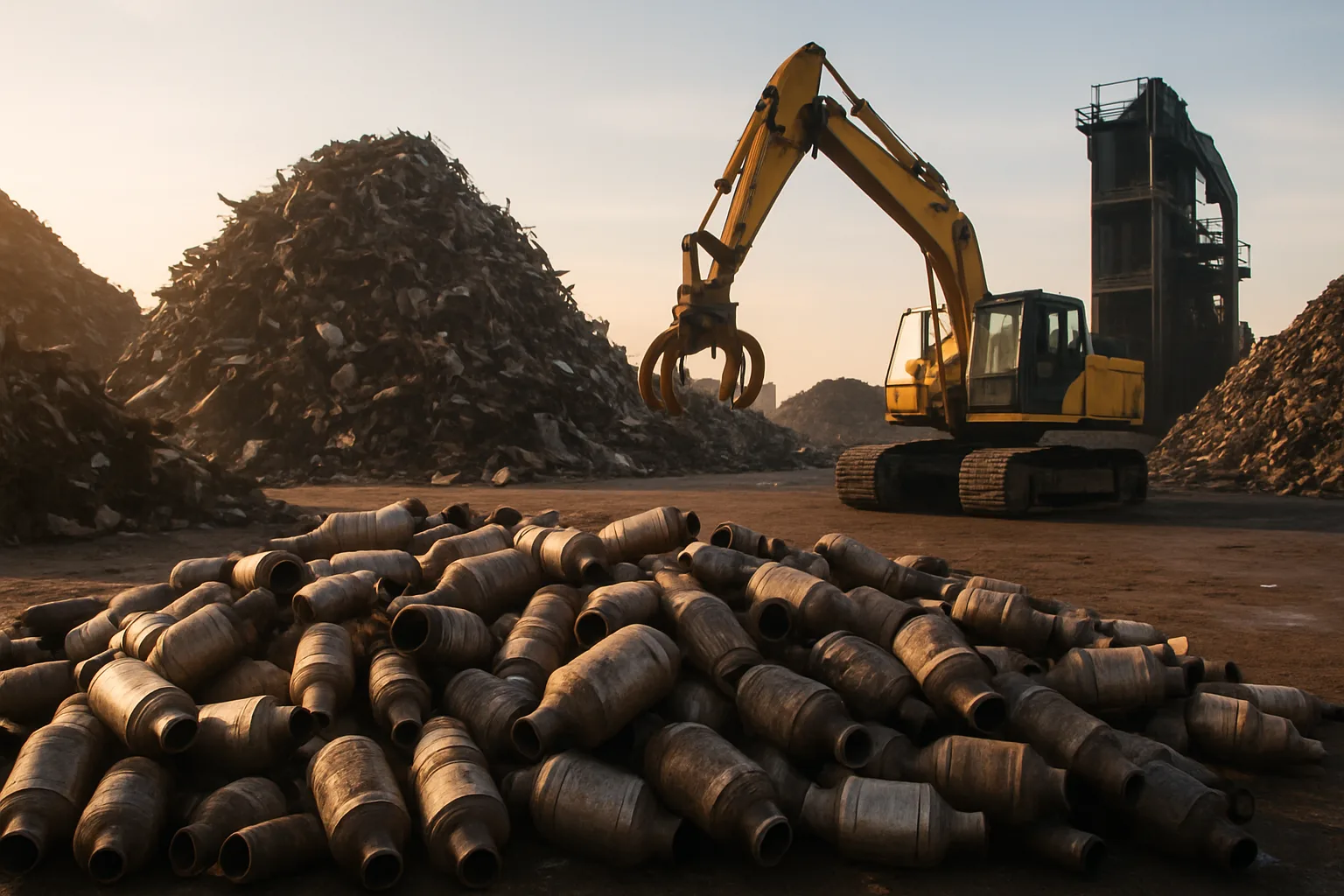
Most scrap yards won't explain why your catalytic converter is worth $40 one week and $180 the next. They'll just quote you a number and move on. If you're selling cats in Saint John or anywhere else in New Brunswick, that opacity costs you money — and it doesn't have to.
Understanding how catalytic converter recycling actually works gives you leverage. You'll know what drives the price, what buyers are really paying for, and how to avoid leaving cash on the table. Let's break it down.
What's Actually Inside a Catalytic Converter
The value in a catalytic converter has nothing to do with the steel shell. It's about what's packed inside the honeycomb substrate: platinum group metals, specifically platinum (Pt), palladium (Pd), and rhodium (Rh). These are the elements that make the catalytic reaction work — converting toxic exhaust gases into less harmful emissions. Buyers aren't buying your cat. They're buying those metals.
The loading of PGMs varies significantly by vehicle type, manufacturer, and model year. A high-end European diesel converter might carry substantially more palladium than a small domestic gasoline engine unit. Diesel cats often have higher platinum content. Hybrid vehicles can carry converters with elevated PGM loads because those engines run intermittently and need more efficient catalytic action. That's why two converters sitting side by side at a Saint John scrap yard can carry very different values — even if they look nearly identical on the outside.
- Platinum: Found in diesel and many gasoline converters. Prices tied to industrial demand and mining supply.
- Palladium: Dominant in gasoline converters. Has seen extreme price swings in recent years.
- Rhodium: Present in smaller quantities but historically the most valuable of the three by weight.
- Substrate material: Ceramic (most common) or metallic. Metallic substrates have some additional scrap value.
None of these metals trade like copper or aluminum. They're priced on their own commodity indexes and driven by entirely different supply and demand factors — including automotive production volumes, mining output from South Africa and Russia, and industrial demand from other sectors.
How Catalytic Converter Recycling Actually Works — Step by Step
From the moment a converter leaves your vehicle to the moment PGMs are extracted, there's a defined industrial process. Knowing it helps you understand why pricing is complex and why the first quote you get may not reflect true market value.
- Collection and sorting: Converters are grouped by type — domestic, foreign, diesel, aftermarket, or "bead" (loose substrate). Each category carries different average PGM yields. Aftermarket converters, for example, typically carry lower PGM loads than OEM units and price accordingly.
- Decanning: The steel shell is cut away to extract the substrate inside. Some processors do this in-house; others ship whole units. Decanned substrate commands different pricing than whole converters.
- Sampling and assaying: Large volumes of substrate get crushed, blended, and sampled. An assay determines the actual PGM content per tonne of material. This is the ground truth — everything else is an estimate.
- Smelting and refining: The substrate goes through a high-temperature smelting process that captures PGMs in a metal collector. From there, chemical refining separates platinum, palladium, and rhodium into pure metals.
- Settlement: The recycler gets paid based on the assayed PGM content, minus processing fees and refining charges. For large-volume sellers, this return-on-assay model is the gold standard for maximizing recovery.
If you're selling individual converters or small lots at a local yard in Saint John, you're not getting assay pricing — you're getting the yard's estimate of what your unit will yield, minus their margin. That's not inherently wrong, but it underscores why competitive pricing and market knowledge matter. Platforms like SMASH Recycling — where verified buyers bid on your metal create the kind of competition that brings those yard estimates closer to actual market value.
Why Catalytic Converter Prices Vary So Much
This is the question every seller in New Brunswick — and across Canada — eventually asks. The short answer: catalytic converter prices are a function of three overlapping variables, all moving independently.
1. PGM spot prices. Platinum, palladium, and rhodium trade on global commodity markets. These prices shift daily based on mining news, automotive production data, industrial demand, and macroeconomic conditions. A sharp drop in palladium spot prices will ripple through to what buyers offer for gasoline converter lots within days, sometimes hours.
2. Converter type and condition. Converters are not commodities in themselves — each type has a different PGM profile. A "high-grade foreign" converter from a late-model Toyota or Honda will price very differently from a "domestic regular" or an aftermarket unit. Damaged, overheated, or rattling converters (failed or loose substrate) carry a fraction of the value of intact units. Condition matters.
3. Market competition at the point of sale. If you're calling one buyer and accepting their quote, you have no reference point. You don't know if that number is at market, below market, or opportunistic. This is where a B2B scrap metal marketplace changes the dynamic entirely. When multiple vetted buyers are competing for the same lot, the price discovery process is real. You see what the market is actually willing to pay — not what a single buyer is willing to offer.
There's also a seasonal and regional dimension. Demand from processors can shift based on refinery schedules, shipping logistics, and local stockpile levels. If you're managing volume in Saint John or anywhere along the Eastern seaboard, understanding that demand isn't uniform across all buyers at all times is genuinely useful market intelligence. You can read Canadian scrap metal pricing guides to track how these regional factors have been playing out in 2026.
Copper Scrap Prices in Saint John — How Cats Fit Into the Bigger Picture
You might be here because you searched copper scrap prices Saint John — and catalytic converters don't contain copper. Fair point. But the reason this matters is that the same pricing dynamics driving copper scrap prices in New Brunswick apply directly to the cat market: global commodity benchmarks, local buyer competition, and the quality of your documentation.
Copper, like PGMs, trades on a global index. Scrap metal prices in Saint John for copper wire, copper pipe, or bare bright copper are tied to the LME copper spot price, adjusted for local market conditions and buyer margins. The yard paying you for a load of #1 copper and the processor assessing your catalytic converter lot are both working backward from a global benchmark to arrive at their offer. In both cases, more buyers competing for your material is the lever that works in your favor.
If you're running a yard or managing mixed loads — cats alongside non-ferrous scrap like copper, aluminum, or brass — understanding that each stream has its own pricing logic is essential. Aluminum scrap value per pound and copper pricing move on different fundamentals than PGMs. Bundling everything into one call with one buyer means you're accepting that buyer's blended estimate across multiple commodity markets simultaneously. That's a lot of pricing power to hand over.
For serious volume sellers, separating streams and putting each one in front of the right buyers is the move. To find the best Canadian scrap metal prices today, that means using tools designed for competitive price discovery — not just calling down a list of local contacts.
How to Maximize What You Get for Catalytic Converters
Whether you're a dismantler in Saint John processing a handful of units a week or a larger operation moving significant volume, the principles are the same. The sellers getting the best prices aren't lucky — they're systematic.
- Identify your converters before you sell. Serial numbers, VIN lookups, and converter databases exist for a reason. Knowing whether you have a high-grade foreign or a domestic standard unit before you negotiate means you walk into the conversation with information, not assumptions.
- Document everything. Photos of each unit, condition notes, and accurate counts give buyers confidence and reduce the discount they apply for uncertainty. Buyers price in risk. Remove the risk.
- Separate by grade. Don't sell mixed lots at single-grade pricing. Sort your inventory — high-grade foreign, domestic, diesel, aftermarket, bead — and price each stream appropriately.
- Get multiple quotes. This is non-negotiable. One quote is not a market. SMASH creates that competitive environment systematically, putting your lots in front of vetted buyers who are actively bidding.
- Understand the timing. PGM markets move. If palladium just dropped 15% on a supply announcement, today might not be the optimal day to move your gasoline converter lot. Staying informed helps you make smarter timing decisions.
For local sellers, connecting with Saint John scrap metal services that understand the regional market is a practical first step — but don't stop there. Regional knowledge combined with platform-level price competition is the combination that consistently produces better outcomes.
Using a B2B Scrap Metal Marketplace for Catalytic Converter Lots
SMASH is built specifically for this. It's a B2B scrap metal marketplace where vetted buyers compete in an auction format for your lots — whether that's catalytic converters, copper wire, aluminum extrusion, or mixed non-ferrous loads. No subscription fees. No guessing. The auction format does the price discovery work that you used to have to do manually by calling buyers one at a time.
For catalytic converter sellers, the platform supports photo documentation and serial tracking — two features that directly address the information asymmetry problem. When a buyer can see exactly what they're bidding on, they bid with more confidence. More confidence means tighter margins, which means more money back to you.
If you're moving volume anywhere in Canada — from Saint John to scrap metal recycling in Mississauga and beyond — SMASH operates across North America. The vetted buyer network isn't regional. That matters when you're trying to find the buyer who actually needs your specific converter grades right now, not just whoever happens to be picking up the phone locally.
Prices fluctuate daily based on commodity markets. Always check current Canadian scrap metal prices before you commit to a sale — what a buyer quoted you last Tuesday may not reflect today's PGM benchmarks. Staying current is the simplest edge you have.
The scrap industry rewards the sellers who treat it like a market, not a transaction. Get competitive. Get documented. Get the price your material actually deserves — check rates at best-scrap-metal-prices.ca and see what the market is doing before your next load moves.
Frequently Asked Questions
Q: Why do catalytic converter prices change so often in Saint John?
Catalytic converter prices are tied to platinum group metal (PGM) spot prices — platinum, palladium, and rhodium — which trade on global commodity markets and shift daily. Local buyers in Saint John adjust their offers based on these benchmarks, plus their own processing costs and margins. A shift in global PGM demand can change what a converter is worth within 24 hours.
Q: How do I know what grade my catalytic converter is?
Most converters can be identified using the serial number stamped or printed on the unit. Converter pricing databases and VIN lookup tools cross-reference these numbers to provide grade and estimated PGM yield. Platforms like SMASH support serial tracking to help sellers document and identify their inventory accurately before going to market.
Q: Do scrap metal prices in Saint John differ from the rest of Canada?
Benchmarks are set globally, but what you actually receive in Saint John reflects local market conditions — buyer competition, shipping logistics to processors, and regional demand. Getting multiple buyers to compete for your lot (rather than accepting one local quote) is the most effective way to close the gap between the benchmark and what lands in your account.
Q: Is it worth separating catalytic converters from other scrap metal before selling?
Absolutely. Catalytic converters price on PGM content — a completely different market from copper, aluminum, or steel. Selling them as part of a mixed load means accepting a blended estimate from a buyer who has every incentive to price in uncertainty. Separating your streams and selling each to the right buyer consistently produces better returns.
Q: What's the best way to get competitive prices for catalytic converters in New Brunswick?
The most reliable approach is to put your lot in front of multiple vetted buyers simultaneously. SMASH operates as a B2B auction platform where qualified buyers compete for your material — no subscription fees, full transparency, and documentation tools built in. For current market pricing before you sell, check best-scrap-metal-prices.ca for up-to-date Canadian scrap metal benchmarks.
Follow SMASH on LinkedIn for ongoing scrap metal market insights, industry updates, and pricing trends across North America.