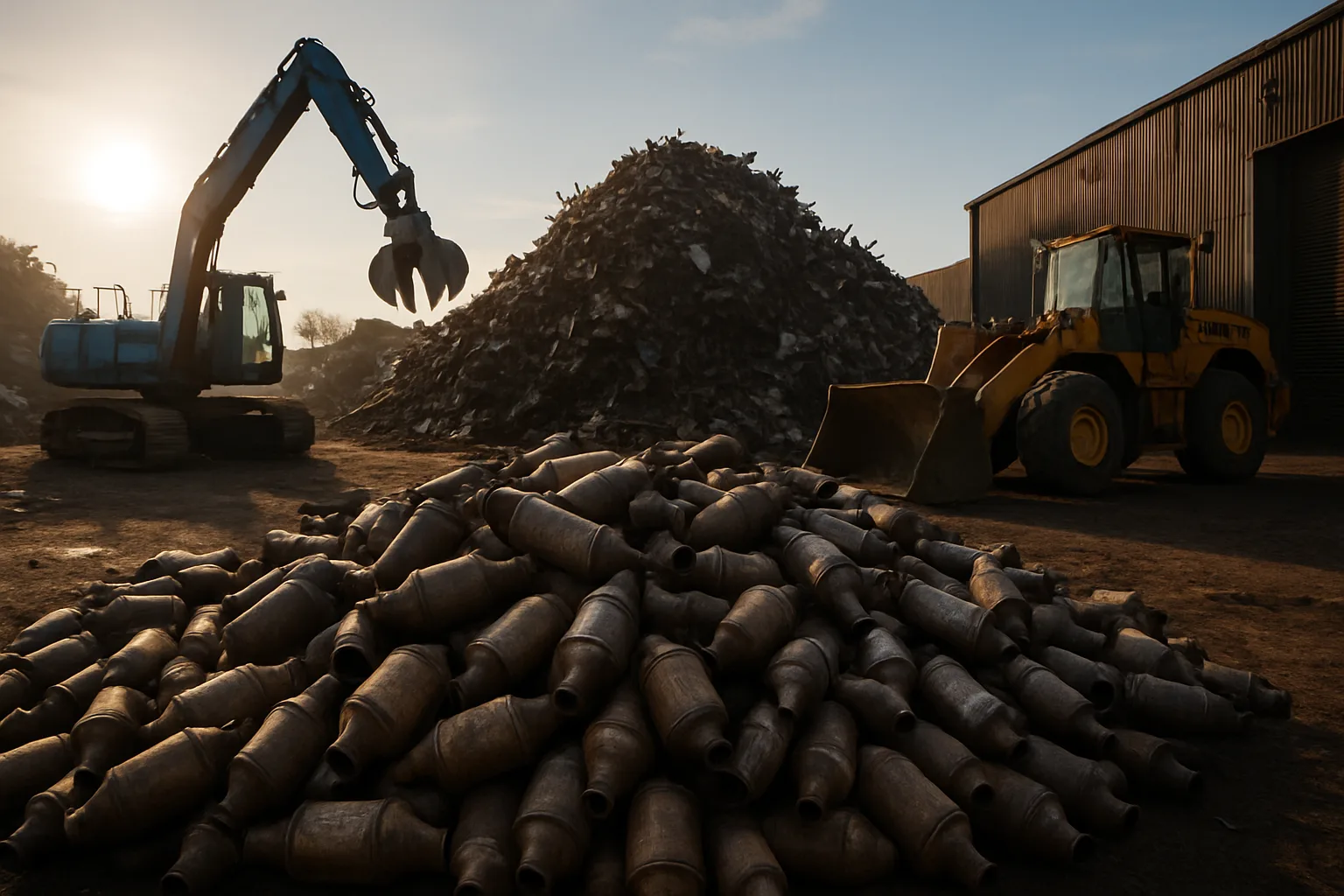
Catalytic Converter Recycling: Why the Price Swings More Than Any Other Scrap
Your catalytic converter could be worth $20 or $400 — and the difference has nothing to do with luck. It comes down to metal chemistry, market conditions, and whether the buyer on the other end of the phone actually knows what they're looking at. Most sellers don't know what drives the value. That information gap costs them real money.
If you're trying to get the best scrap metal prices London has to offer on catalytic converters, you need to understand how the recycling process works — and why prices vary so wildly from one yard to another. This article breaks it down in plain language so you stop leaving money on the table.
What's Actually Inside a Catalytic Converter That Makes It Valuable
The steel shell means almost nothing. What matters is what's inside: a ceramic or metallic substrate coated with platinum group metals — specifically platinum (Pt), palladium (Pd), and rhodium (Rh). These three metals are the entire reason the recycling industry pays serious money for cats.
Platinum group metals are rare, industrially critical, and heavily traded on global commodity exchanges. Rhodium in particular has historically been one of the most volatile metals in the world — swinging from a few hundred dollars per troy ounce to several thousand and back again within a single year. When rhodium spikes, cat prices spike. When it drops, the market shifts almost overnight. That's not speculation — it's how the commodity pricing chain works from the refinery all the way back to your yard.
- Platinum: Used in diesel vehicle converters primarily; a key pricing driver in heavy-duty and commercial vehicles
- Palladium: Dominant in gasoline vehicle converters; demand surged as gasoline engines became the global standard
- Rhodium: Present in smaller amounts but often the highest-value metal by weight; extreme price volatility
The concentration of each metal varies by vehicle make, model, year, engine type, and whether the converter is OEM or aftermarket. A factory-installed converter from a full-size truck typically carries more substrate material — and more PGMs — than a compact car's aftermarket replacement. That's why buyers quote specific part numbers when they can get them.
How the Recycling Process Actually Works — From Your Yard to the Refinery
Understanding the process helps you understand why pricing isn't a simple per-unit number. Catalytic converters don't pay out like aluminum or copper, where you weigh the load and apply a price per pound. The PGM recovery process involves multiple steps and multiple parties.
Here's how the chain typically runs:
- Collection: Converters are pulled from vehicles at recycling yards, auto wreckers, and body shops. Volume matters — most processors want truckload quantities, not a handful of units.
- Identification and grading: Experienced buyers identify converter types by visual inspection, part numbers, or VIN lookup. This step is where most small sellers get undervalued — if the buyer can't or won't identify the unit properly, they'll lowball to cover their risk.
- Decanning: The substrate is removed from the steel shell. The shell gets recycled separately as steel scrap. The substrate is what gets assayed.
- Sampling and assay: The substrate is processed into a powder, sampled, and sent for lab assay to determine exact PGM content per unit. This is the definitive pricing step.
- Smelting and refining: The PGMs are extracted and refined into pure metal. The refinery pays the processor based on assay results, minus refining fees and settlement terms.
This multi-step chain means price discovery at the street level is always an estimate. Buyers quote based on historical assay data for known converter types — what the industry calls "assay-based pricing by series." The more data a buyer has, and the more honestly they apply it, the closer your quote will be to actual value. Platforms like SMASH Recycling — where verified buyers bid on your metal create competitive tension in that quoting process, which is exactly what sellers need.
Why Catalytic Converter Prices Vary So Much — Even for the Same Unit
This is the part most sellers don't fully grasp. Two yards in London, Ontario can quote wildly different numbers for the same converter. That gap isn't always dishonesty — though that exists too. It comes from several structural factors in how cats are priced.
1. Market timing. PGM spot prices move daily. A quote you got last Tuesday may already be stale by Friday. Rhodium especially can shift dramatically in a short window. Buyers who haven't updated their price books are quoting you yesterday's market.
2. Volume and relationship pricing. A yard moving thousands of units monthly gets better downstream pricing than one moving a few hundred. That margin gets passed back to sellers — or doesn't, depending on who's buying.
3. Identification accuracy. If a buyer misidentifies your converter as a lower-grade unit, they quote accordingly. This happens more than people realize. VIN lookup tools and serial tracking dramatically reduce misidentification. Using a B2B scrap metal marketplace with documented photo submission and serial tracking means buyers are quoting the actual unit — not their best guess.
4. Overhead and margin structure. Some buyers are running tight operations with direct refinery relationships. Others are middlemen taking a cut at every step. Each layer of margin reduces what gets back to you.
5. Aftermarket vs. OEM converters. Aftermarket converters typically have significantly lower PGM loading than OEM units. A buyer who can't distinguish between them either charges a flat rate (undervaluing good OEM units) or quotes OEM pricing on everything (overpaying on aftermarket, which they compensate by low-balling across the board).
If you want to find the best Canadian scrap metal prices today, the single most effective move is getting multiple competitive quotes simultaneously — not calling one buyer and hoping for the best.
What a Real Case Looks Like: Getting More from Your Cat Load
Consider a recycling yard in London that regularly pulls converters from end-of-life vehicles. In the old model, they'd call one established buyer, get a per-unit price, and load up a skid. No documentation. No second opinion. No visibility into whether the quote reflected current PGM prices or last month's.
When that same yard started using a B2B scrap metal marketplace with photo documentation and serial tracking per unit, something shifted. Buyers bidding on the load could see exactly what they were quoting. No ambiguity about unit type. No catch-all lowball pricing to cover uncertainty. The competition between vetted buyers — rather than a single take-it-or-leave-it call — gave the yard actual price discovery instead of a guess dressed up as a quote.
This isn't a pitch. It's how market mechanics work. More buyers with better information produce better outcomes for sellers. That's the structural argument for using SMASH over the single-call method, whether you're operating in London, Hamilton, or looking for the best scrap metal prices in Calgary.
Documentation matters too. A load of converters with photos, part IDs, and serial numbers attached commands more buyer confidence than an unmarked skid. Buyers price uncertainty into their quotes. Remove the uncertainty, and that margin comes back to you.
How to Get Better Prices on Catalytic Converters in London and Across Ontario
There's no trick here. It's process discipline. Do these things consistently and you'll get closer to actual market value on every load.
- Document your inventory before it leaves the yard. Photo each unit. Record the serial number or VIN where available. This takes minutes and pays back in buyer confidence.
- Know what you have before you call anyone. OEM vs. aftermarket, diesel vs. gasoline application, make and model where identifiable. The more specific you are, the more accurately buyers can quote.
- Get multiple quotes simultaneously. Not sequentially — simultaneously. Sequential quoting lets buyers low-anchor your expectations. Simultaneous competitive bidding gives you a real market price.
- Track PGM spot prices. You don't need to become a commodity trader. But knowing whether platinum and palladium are up or down this week tells you whether it's a good week to move a load or wait.
- Work with vetted buyers who deal in volume. Casual buyers without refinery relationships are taking a margin at your expense. Established buyers with direct access to processors can offer better pricing and reliable payment.
If you're in London or anywhere in Ontario and still calling one buyer per load, you're not getting a market price. You're getting that buyer's price. Those are different things. To check current Canadian scrap metal prices and understand what the market is actually paying, you need comparison — not convenience.
For a deeper look at how pricing works across different metals and regions, read Canadian scrap metal pricing guides that cover everything from copper and aluminum to specialty materials like catalytic converters.
If you're ready to move beyond the single-buyer phone call and see what competitive bidding actually does for your cat loads, London scrap metal services can connect you with the right buyers. And if you want to sell scrap metal Hamilton or other Ontario markets through a vetted buyer network, the same process applies — document, compete, sell.
Prices fluctuate based on daily PGM spot rates, load composition, and buyer demand. Always verify current rates before finalizing any sale. For the most accurate pricing available right now, get the best Canadian scrap metal prices — check rates at best-scrap-metal-prices.ca before your next load moves.
Frequently Asked Questions
Q: Why do catalytic converter prices vary so much between yards in London?
PGM spot prices change daily, buyer overhead structures differ, and not every yard has the identification tools to accurately grade what they're buying. Misidentification and stale price books are two of the biggest causes of underquoting. Getting multiple bids from vetted buyers simultaneously closes that gap significantly.
Q: How do I know if my catalytic converter is OEM or aftermarket?
OEM converters typically carry a part number stamped on the shell that corresponds to the original vehicle manufacturer's specs. Aftermarket units often have a generic brand stamp or no marking at all. If you have the vehicle VIN, a VIN lookup tool can help identify the original converter specs for that vehicle.
Q: What's the best way to get the best scrap metal prices in London for a load of catalytic converters?
Document each unit with photos and serial numbers before listing. Then expose the load to multiple vetted buyers at the same time rather than calling one yard. Competitive bidding reveals the actual market price — a single call just gives you one buyer's number. A B2B scrap metal marketplace structures that competition for you.
Q: Do PGM prices affect what I get paid the same day I sell?
Most buyers quote based on current spot prices at time of transaction, but settlement terms vary. Some buyers pay on delivery at a fixed quote; others pay on a percentage-of-assay basis after the load is processed at a refinery. Understand the settlement terms before you agree to a price — they're part of the total value equation.
Q: Is it worth holding catalytic converters and waiting for higher PGM prices?
It depends on your storage capacity, cash flow needs, and your read on the market. Rhodium and palladium are historically volatile, so timing the market is genuinely difficult. Most operators find consistent process discipline — documentation, competitive bidding, vetted buyers — delivers better results than trying to time commodity cycles.
Follow SMASH on LinkedIn for ongoing scrap metal market insights and industry updates: linkedin.com/company/scrap-metal-auction-sales-hub